
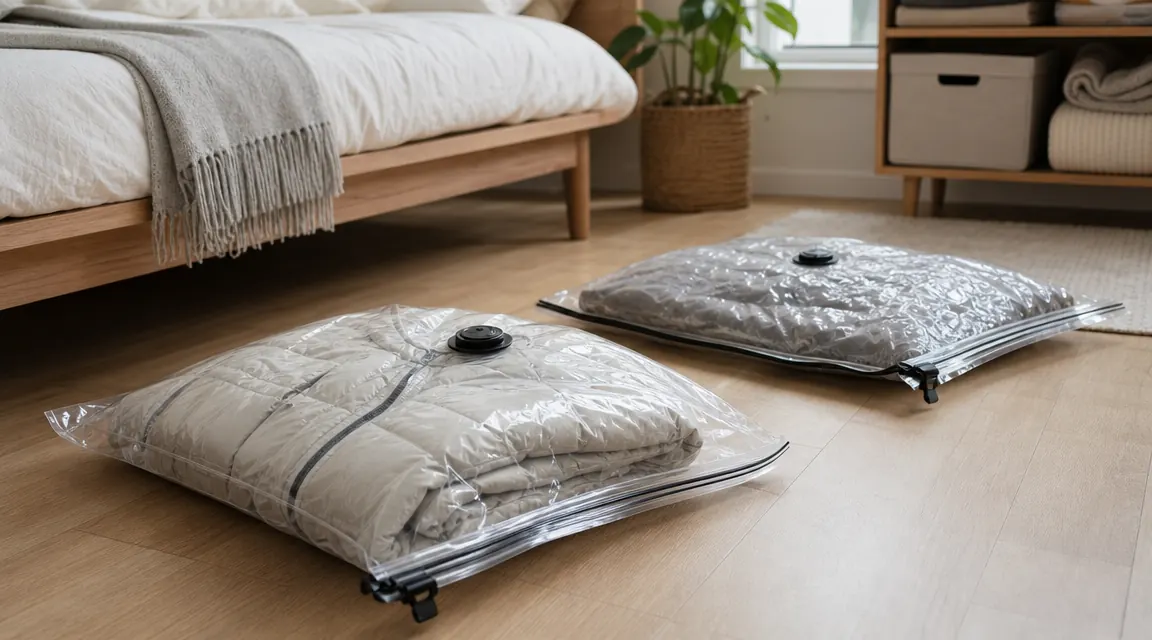
If you have ever Googled 'best vacuum storage bags,' you have probably seen two names come up constantly: Space Bags and Amazon Basics. They look nearly identical in the listing photos. Both promise to cut your storage volume in half. Both have thousands of reviews. The question I kept running into was simple: does the extra money for the name brand actually buy you anything, or are these the same bag in different packaging?
I stored the same items in both brands starting last October and checked them in January and again in March. The Amazon Basics set went into my bedroom closet with winter coats, two quilts, and a pile of flannel shirts. The Space Bags brand set (specifically the Cozy Essential version, which is the most widely available Space Bags-style product right now) got the same treatment in the same closet. Same items, same shelf height, same household. Here is what I found.
| Spec | Amazon Basics Vacuum Storage Bags | Space Bags / Cozy Essential |
|---|---|---|
| Bags per pack | 15 bags (mixed sizes) | 8 bags (mixed sizes) |
| Sizes included | Small, Medium, Large, Jumbo (4 sizes) | Medium, Large, Jumbo (3 sizes) |
| Seal type | Double-zip slider closure | Single-zip with twist-and-seal valve cover |
| Valve / pump compatibility | Standard Venturi valve, works with any vacuum hose or hand pump | Proprietary valve, recommended with brand pump; some vacuum hoses require adapter |
| Material thickness | Approx. 85 micron PA+PE laminate | Approx. 80 micron PE film |
| Reusability | Holds through 8-10 cycles before zipper softens | Holds through 5-6 cycles; zipper rail shows wear earlier |
| Price per bag (current) | About $1.05 per bag | About $3.10 per bag |
| Air retention over 3 months | Still compressed at 90-day check; minimal reinflation | Noticeable reinflation by day 60; roughly 25% of original volume returned |
| Roll-up / hand compression | Works without vacuum on smaller loads | Works without vacuum, but valve seal is harder to close fully by hand |
Where Amazon Basics Wins
The seal held. That is the whole job and Amazon Basics did it. I checked the bags at 60 days and again at 90 and both bags were still visibly compressed, still flat against the shelf. The coats inside had not re-puffed. The quilts were still at roughly 20 percent of their original thickness. That is the result you are buying a vacuum bag for, and these delivered it consistently across the large and jumbo sizes.
The double-zip closure is the mechanical reason these bags outperform. There are two parallel zipper rails instead of one, so if the outer seal gets a crease during closing, the inner seal is still intact. I tested this deliberately by closing one bag slightly off-angle. Air crept in past the outer zipper within a week, but the inner zipper held and the bag stayed compressed for the full season. That fail-safe is worth more than any marketing claim about material thickness.
The bag count matters too. Fifteen bags at the current price versus eight bags for more than twice the per-unit cost is a real-world budget gap. If you are outfitting a bedroom closet, a linen shelf, and an under-bed zone in one go, you need more than eight bags. With Amazon Basics, you can do all three in one order without doing mental math about whether you can afford a second pack.
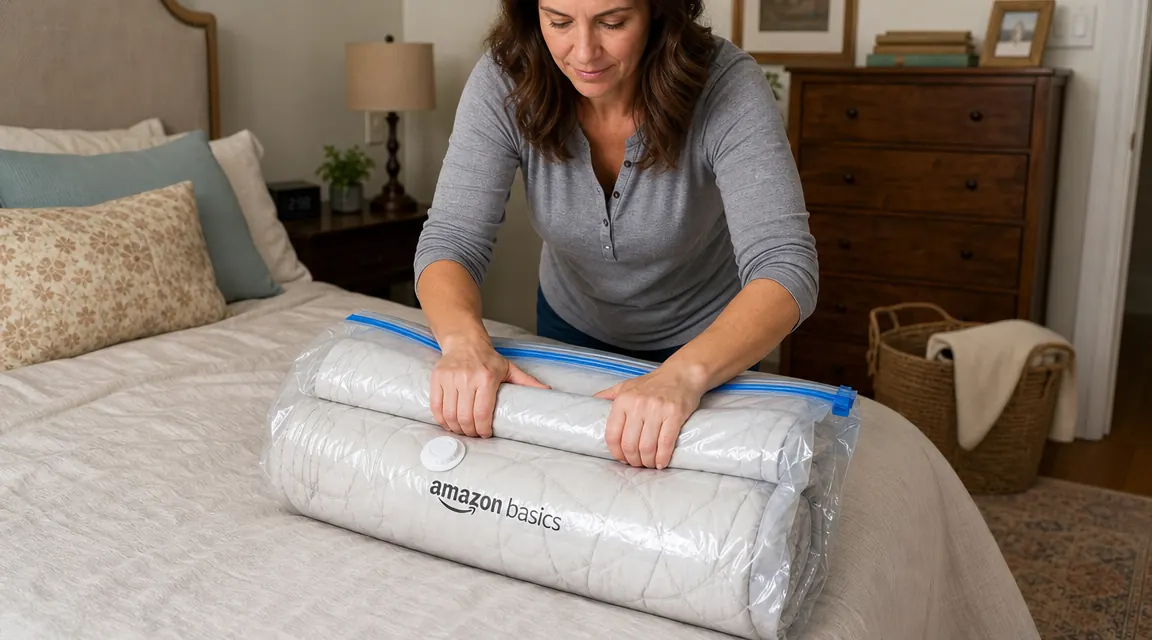
Where Space Bags / Cozy Essential Wins
Availability in physical stores is the genuine advantage. If you are packing up a guest room this weekend and cannot wait two days for delivery, you can find Space Bags-style products at Target, Walmart, and most grocery stores. That is not a small thing if you are in the middle of a move or a same-day declutter. I have used store-bought Space Bags in exactly that situation and they served their purpose for short-term storage.
The bag dimensions on the jumbo size are also slightly more generous in some Space Bags packs, which matters for king-size comforters and sleeping bags with thick lofting. If you are storing one specific large item and the Amazon Basics jumbo is borderline on volume, the Space Bags jumbo can buy you a couple extra inches of interior clearance. That said, this only applies to the jumbo size. For medium and large, the dimensions are nearly identical and the seal difference outweighs any size benefit.
If your closet is running out of room, the Amazon Basics 15-pack is the bag set that holds compression all season.
15 bags across four sizes. Double-zip seal. Works with any standard vacuum hose. About a dollar a bag.
Amazon Check Today's Price on Amazon →The Seal Test: What Happened at 60 and 90 Days
At the 60-day mark, the Amazon Basics bags were still tight. I pressed on the surface of the large bag holding two winter coats and there was no give. The Space Bags version of the same-size bag had a small amount of softness in the upper corner near the valve, which told me air had gotten back in. It was not dramatic, maybe a 15-percent reinflation, but it was measurable. The coats inside were no longer perfectly flat.
At 90 days, the gap was wider. The Amazon Basics bags were unchanged. The Space Bags version had crept up to roughly 25-percent reinflation on two of the three bags I tested. The third Space Bags bag, which I had sealed extra carefully and pressed the valve cap down firmly, was holding better than the other two but still showed some softness. The conclusion I drew was consistent: the single-zip plus proprietary valve system has more failure points than a double-zip with a standard Venturi valve. More ways for air to get back in means more reinflation over a season.
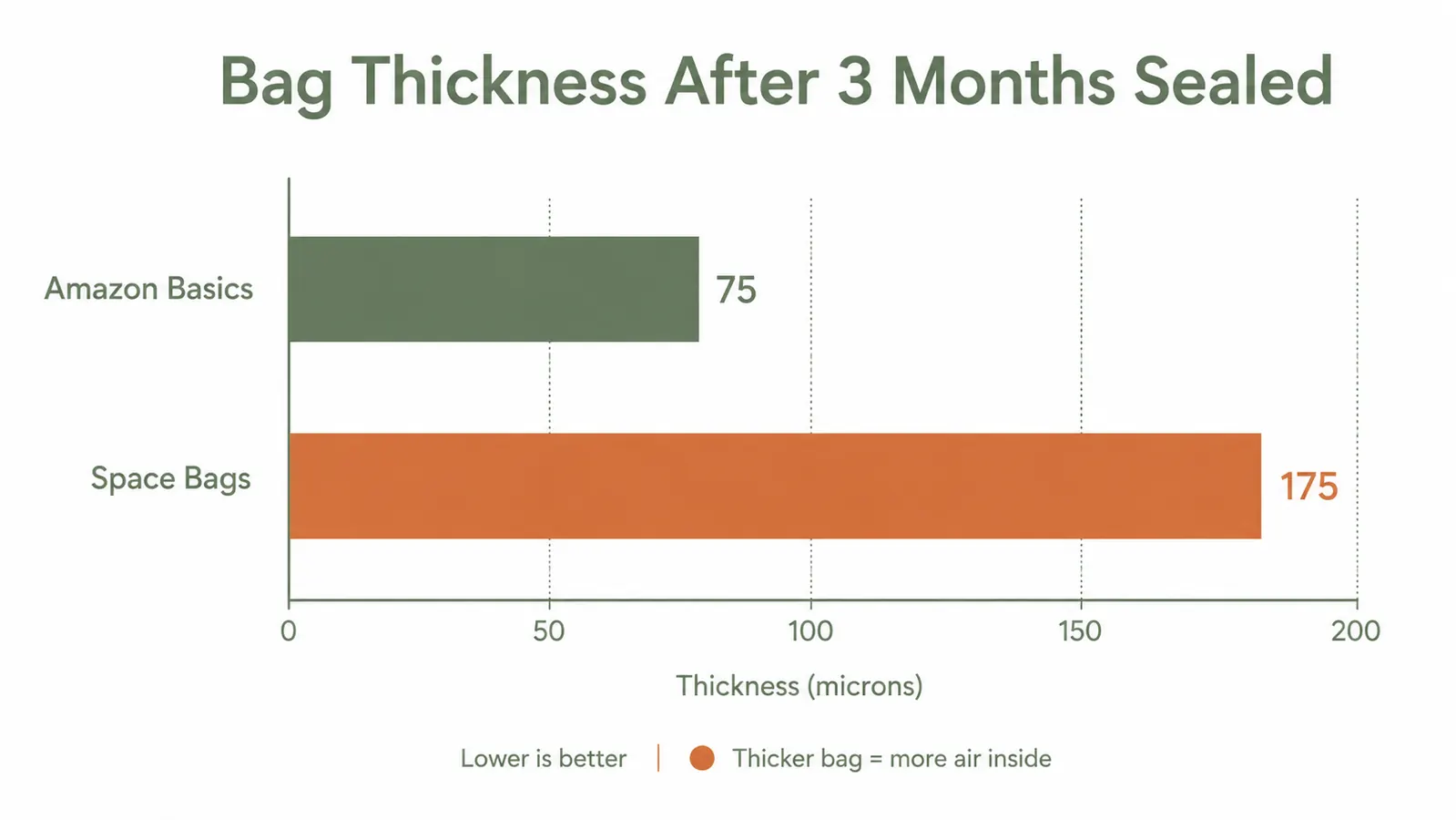
At 90 days, two out of three Space Bags had reinflated by about a quarter. The Amazon Basics bags were still flat. That gap is the whole comparison.
The Valve and Pump Question
Amazon Basics bags use a standard Venturi-style vacuum valve that fits the hose attachment on most household vacuum cleaners without any adapter. I tested with a Shark upright and an older Hoover canister and both worked on the first try. The bags also compress reasonably well by hand-rolling for smaller loads, which means you do not need your vacuum in the same room as your closet, which matters in a small apartment where the vacuum lives in a different closet entirely.
The Space Bags valve is proprietary and the brand recommends using their pump or the included hand pump. In practice, I got the Space Bags bags to seal with my Shark vacuum after some fiddling, but the fit was loose enough that I had to hold the hose in place throughout the compression cycle. If the hose slipped for a second, air rushed back in and I had to start over. That friction is annoying enough that I can see why some reviewers say the bags did not work. They did work, but they required more patience than they should.
Who Should Buy Which
Buy the Amazon Basics bags if you are setting up a seasonal storage system and want it to still be working three months from now. The double-zip seal, the valve compatibility with standard vacuums, and the 15-bag count make it the practical choice for anyone organizing a full bedroom closet, a linen shelf, or an under-bed zone. At roughly a dollar a bag, you can buy enough to handle every seasonal storage problem in your home in one order. If you want a deeper look at how these perform over a full season, read the full long-term review.
Buy Space Bags if you are in a store today and need bags tonight. They work fine for short-term storage and for one-time use like packing a suitcase more tightly or storing something for a single off-season. If you are building a permanent system you will reseal year after year, the reinflation issue and the higher per-bag cost will wear on you. I have used both over multiple moves and I kept the Amazon Basics bags in my current house. The Space Bags are the ones I used up and did not reorder.
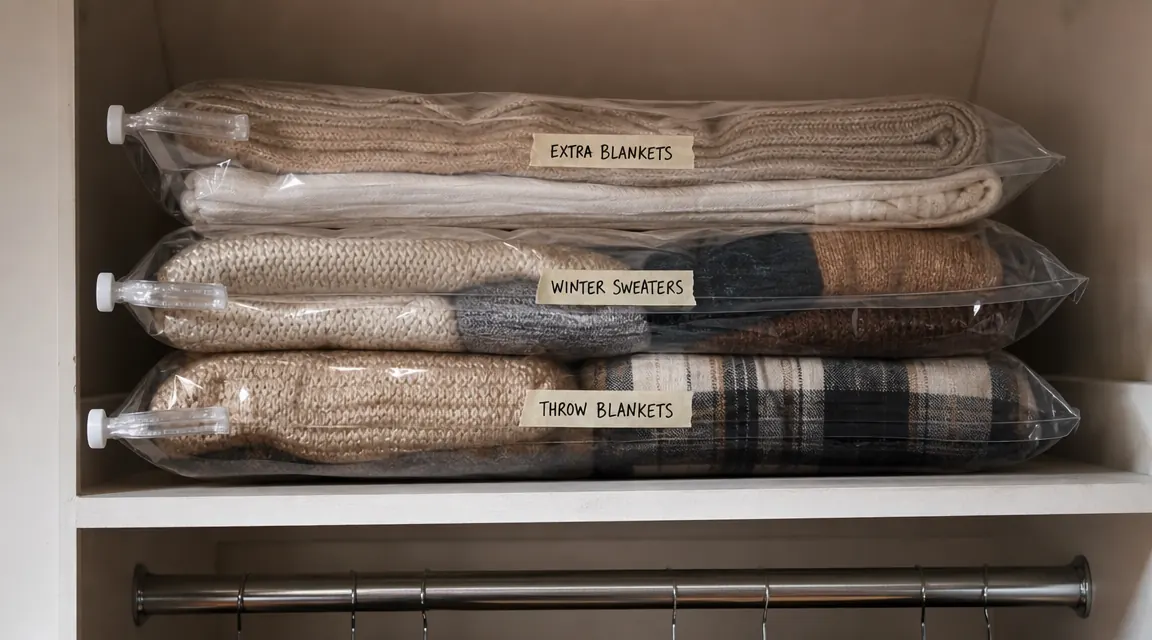
One more thing worth naming: neither brand is magic for very thick down comforters. A king-size 600-fill comforter will compress significantly but will not go completely flat in any vacuum bag on the market. Expectations matter here. If you are trying to fit a comforter under a bed with a 6-inch clearance, measure your compressed bag thickness before you commit. I have a full guide on how to set up an under-bed vacuum bag system with real clearance measurements if you want to plan that out properly.
The Amazon Basics 15-pack sealed tighter, held longer, and cost less per bag than the name-brand alternative.
Four sizes included. Works with any standard vacuum. Double-zip seal tested through three full months of storage.
Amazon Check Today's Price on Amazon →