
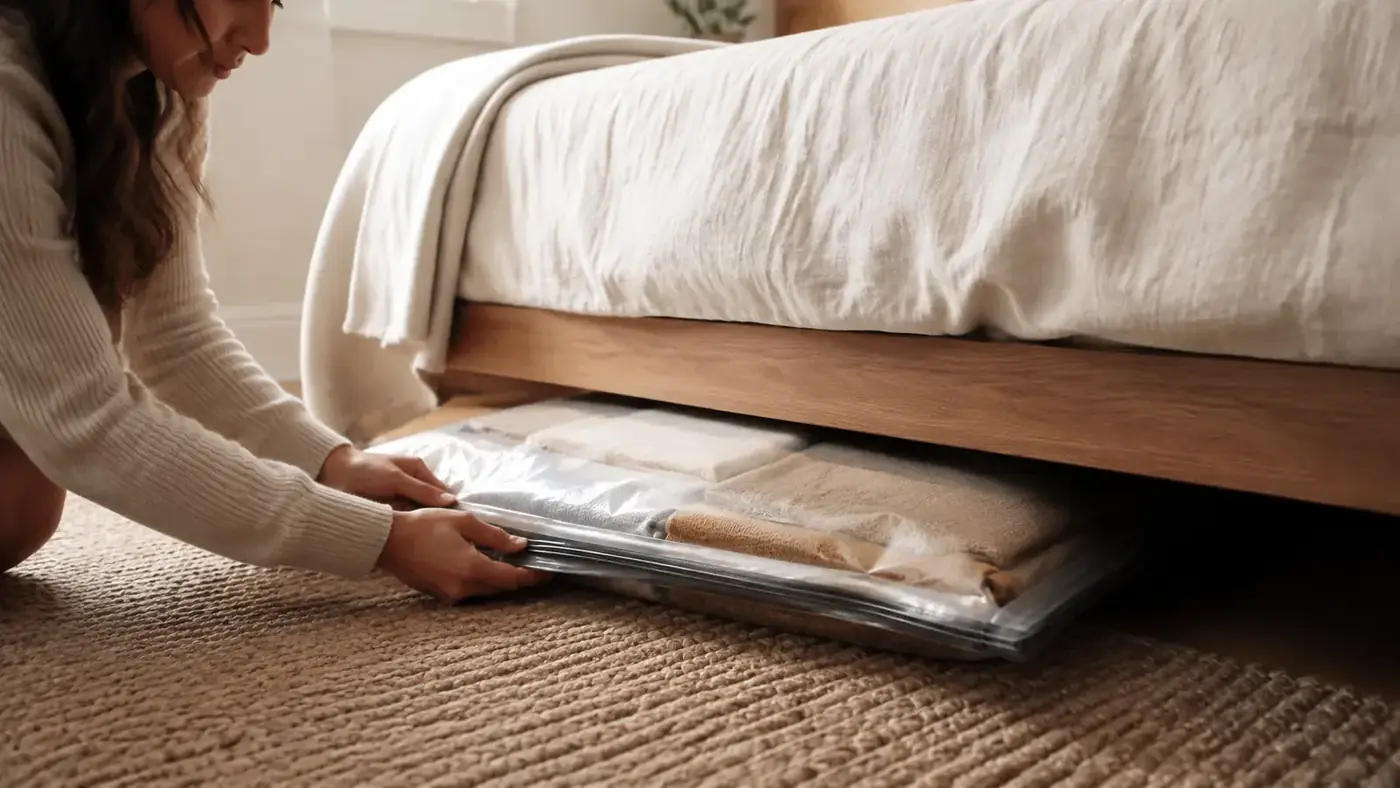
My current bedroom has exactly one closet. It is a shallow reach-in that measures 24 inches deep, which sounds fine until you realize it has to hold year-round clothes for two adults plus a king-size extra-warmth comforter that looks like a marshmallow wearing another marshmallow. Last October, I measured my under-bed clearance (9.5 inches on a platform frame), bought a set of Amazon Basics vacuum storage bags, and sealed up everything I would not need until April. I kept a list of what went in each bag and when I opened them. This is that report.
The short version: the bags worked better than I expected on the large and jumbo sizes, worse than I expected on the medium sizes, and the valve on one of the six bags failed at around the three-month mark. If you are storing a couple of winter coats and a comforter, you will probably be happy. If you are expecting the smaller bags to stay vacuum-tight for five or six months, lower your expectations now.
The Quick Verdict
A reliable, budget-friendly storage upgrade for seasonal clothes and bedding, with one real weakness: the medium-size bags lose their seal faster than the jumbo and large ones.
Amazon Check Today's Price →Your closet is full and your under-bed space is empty. Here is the fix.
The Amazon Basics vacuum storage bags compress a full winter wardrobe down flat enough to slide under most bed frames. Check current availability and multi-pack options.
Amazon Check Today's Price on Amazon →How I've Used Them
I bought a six-bag set: two jumbo (roughly 31 by 40 inches), two large (24 by 32 inches), and two medium (16 by 24 inches). My packing list for October was specific. Jumbo bag one: my husband's Carhartt heavy work coat plus a fleece liner jacket, a quilted vest, and a wool blazer he wears maybe twice a year. Jumbo bag two: my king-size synthetic-fill comforter and a flannel duvet cover. Large bag one: my own down-blend parka plus a heavy cardigan and a lightweight puffer I wear in shoulder seasons. Large bag two: two bed pillows I swap out for thinner summer pillows in spring. Medium bag one and two: assorted flannel pajamas, thermal undershirts, and heavy wool socks.
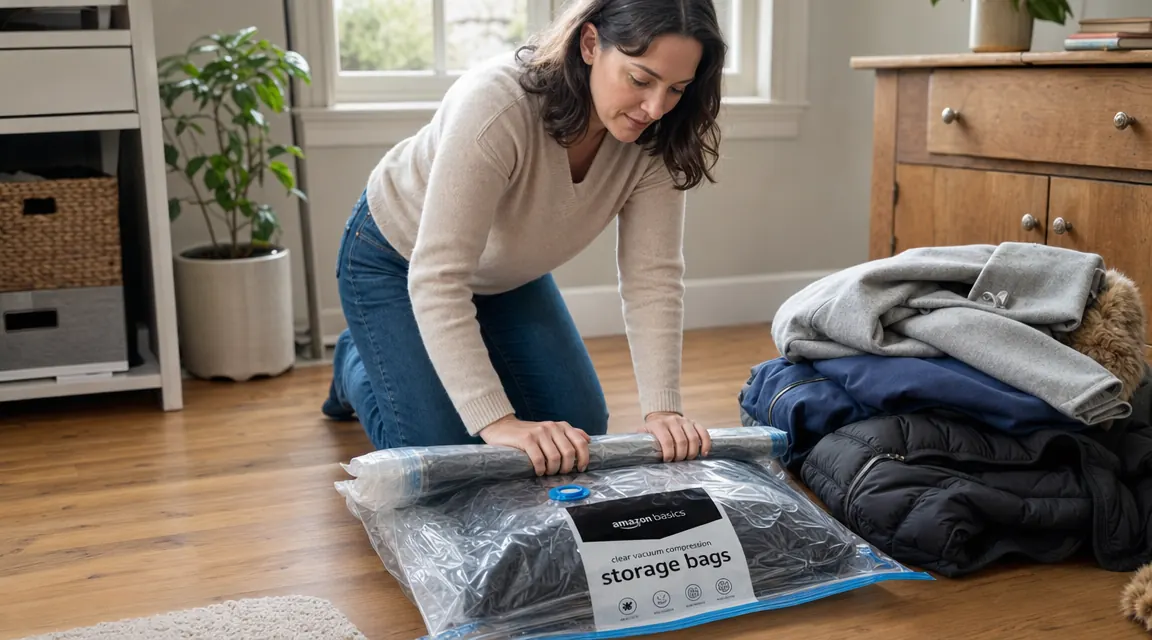
Packing procedure: fold everything as flat as you can, load the bag, zip the seal, then either use a vacuum with the hose attachment on the valve or do the roll-and-press method where you squeeze the air out manually. I used a vacuum for the jumbo bags and rolled the medium and large ones by hand. Both methods worked. The vacuum method gets you maybe 15 to 20 percent more compression. For the jumbo comforter bag, that difference mattered: vacuum got it to just under 3 inches thick; rolling by hand left it at about 4.5 inches. The 9.5-inch clearance under my bed meant both would fit, but the vacuum-sealed bags left more room.
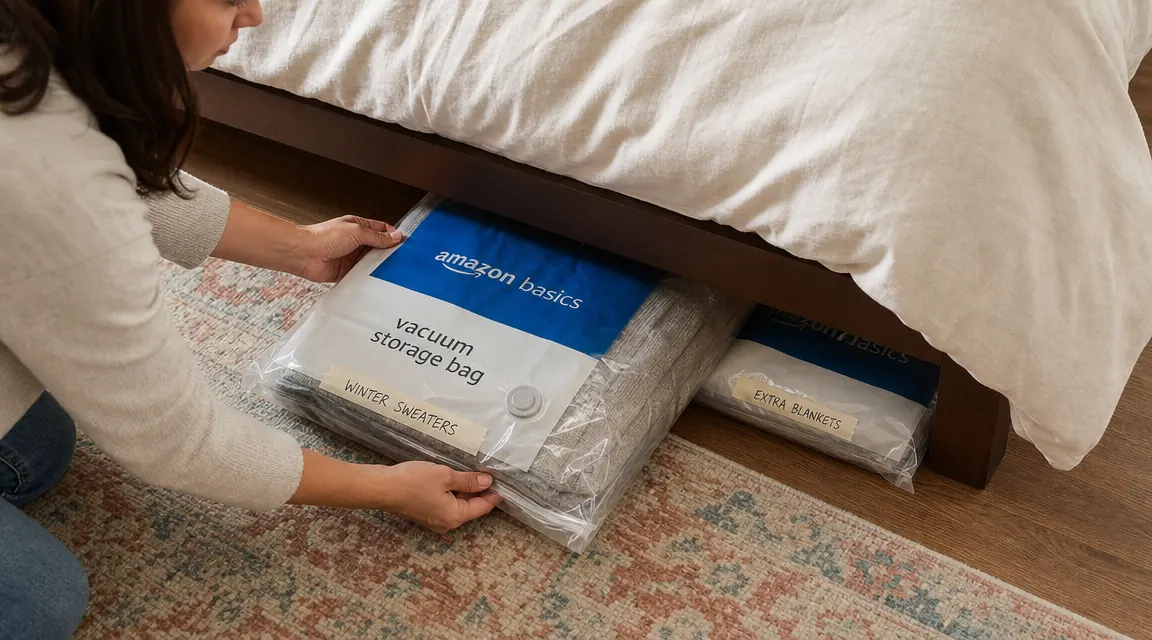
After sealing, I labeled each bag with masking tape and a Sharpie (contents, date sealed, target re-open date) and slid them under the bed. I checked on them at the 30-day, 60-day, and 90-day marks by pressing the surface to see if they had lost rigidity.
Compression Results by Bag Size
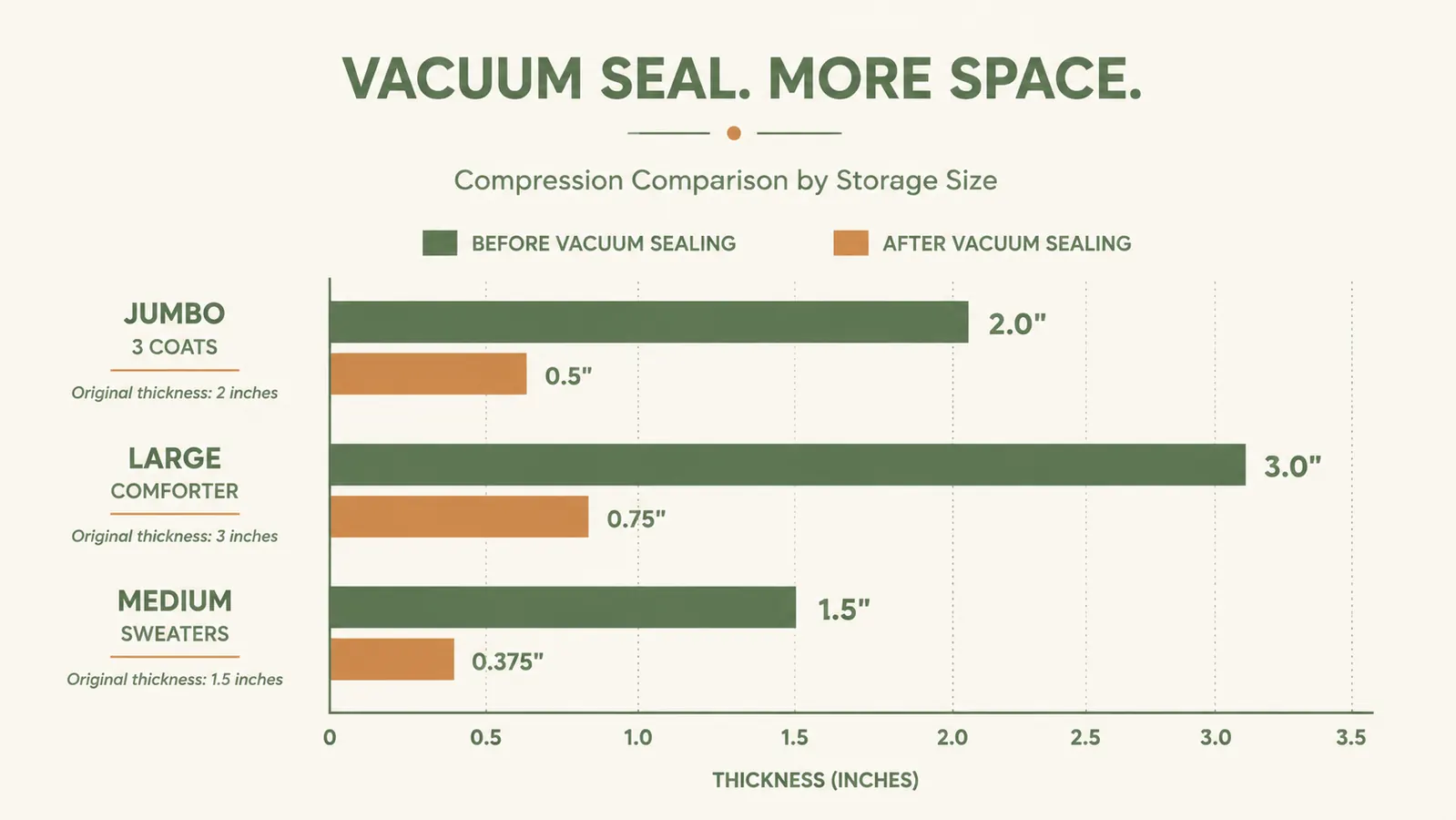
The jumbo bags were the clear winners. Jumbo bag one started at a folded pile about 14 inches thick with all the coats inside. After vacuum sealing, it measured 2.5 inches at the thickest point. That is an 82 percent volume reduction, which is better than I expected. Jumbo bag two, which held the king comforter and duvet cover, went from a pile roughly 18 inches tall down to 3.25 inches. Both jumbo bags held their seal for the full six months with no noticeable air re-entry.
The large bags performed nearly as well. Large bag one (parka plus cardigan plus light puffer) sealed down to 2 inches thick from an original folded thickness of around 9 inches. Large bag two (two pillows) went from a fluffy 10-inch stack to just under 3 inches. Both large bags were still tight at the six-month check in April, though the pillow bag had lost a small amount of compression, maybe 10 percent compared to its Day 1 profile. Still flat enough to stay under the bed without issue.
The medium bags are where I would temper expectations. Medium bag one held flannel pajamas and thermals. It was vacuum-sealed to about 1.5 inches at Day 1. By the 90-day check, it had puffed back to roughly 2.5 inches. Not enough to cause a problem, but it was clearly not holding the same seal. Medium bag two failed more noticeably: by December, about 60 days in, it had returned to close to its pre-seal thickness. I re-sealed it and got another 6 to 8 weeks before it softened again. I ended up treating the medium bags as light compression storage rather than long-term vacuum storage.
Seal Durability Over Six Months
The zipper seal on these bags has a double-track closure, similar to a heavy zip-lock. You run the provided slider along the track to close it, then press the ends firmly. On the jumbo and large bags, I had zero seal failures over six months. The seam felt solid every time I checked. The valve, which is a one-way suction port, is the more vulnerable component, and that is where I had my one real failure.
One of the large bags (the one holding the summer pillows) developed a slow valve leak between months two and three. I noticed it because that bag felt noticeably softer than its twin at my 90-day check. The valve cap was still in place, so the issue was internal. I transferred the pillows to a fresh bag from the second set I had purchased as backup, and the problem did not recur. Amazon Basics does not include replacement valves, which I consider a genuine design gap. If you are planning long-term storage, buy two sets and use the spare bags as replacements if a valve fails.
Jumbo bag one held four heavy winter coats at 2.5 inches thick for six straight months. That was the result I needed. The medium bags are a different product.
What Came Out in April
I opened all six bags on the same afternoon in mid-April and did a full inspection before putting anything back in the closet. The coats came out with the expected post-storage wrinkles, nothing worse than clothes that sat in a suitcase for two weeks. A short time on a hanger in a warm room was enough to drop the worst creases without ironing. No mildew smell, no mustiness, no moisture. The comforter and duvet cover came out clean and re-lofted within about two hours of being laid flat. The flannel pajamas from the medium bags smelled fine and showed no damage.
The one thing I want to flag for anyone storing down or down-blend items: compressing down for long periods can affect fill power. My parka has a stated 650-fill-power rating. After six months of compression, it re-lofted to roughly 80 to 85 percent of its original volume and leveled off there. If you own a high-fill-power down jacket you care about protecting, store it in a large bag rather than a jumbo (less compression) and do not go beyond five or six months of storage. For synthetic fills like my comforter, I noticed no degradation.

Bag Dimensions vs. What Actually Fits
The listed dimensions are for the flat bag before loading. The usable interior is a few inches smaller on each edge because of the seam allowance and the zipper track. For the jumbo bags, the stated 31 by 40 inches translates to a usable loading area of roughly 28 by 36 inches. That is enough for a king comforter folded in thirds or four adult jackets laid flat. For the large bags, the stated 24 by 32 inches gives you about 21 by 28 inches of usable space, which fits a queen duvet or two adult coats with room.
The medium bags at 16 by 24 stated dimensions end up around 13 by 20 inches usable. That is a small footprint. It works for folded sweaters, bundled socks, and flat items, but if you try to stuff a bulky hoodie in there you will fight with the zipper. The medium bags are best used for soft, compressible items that do not have a lot of natural loft.
For under-bed storage specifically: the final sealed thickness is the number that matters, not the footprint. At 2.5 to 3 inches, the jumbo bags fit under any bed with standard frame legs. If you have a platform bed with less than 6 inches of clearance, the jumbo bags still work but the large and medium bags give you more stacking flexibility. I have a guide on reclaiming under-bed space that walks through the exact measurement process if you want to check your clearance before buying.
What I Liked
- Jumbo and large bags hold their seal for a full season with no intervention
- Real compression ratios: jumbo bags reduced volume by 80 percent or more
- Clothes and bedding came out clean, dry, and odor-free after six months
- The double-track zipper seal is solid on the larger bag sizes
- Works with standard vacuum hose or manual roll method, no special pump needed
- Flat enough to slide under a platform bed at 9.5 inches of clearance
Where It Falls Short
- Medium bags lose compression over time, usually by month two or three
- One out of six valves failed in this test set, no replacements included
- High-fill-power down items may not fully re-loft after long compression periods
- Bag dimensions on the listing are pre-load, usable interior is noticeably smaller
- No reusable label slots built into the bag, you are on your own for labeling
Who This Is For
These bags are a good fit if you have a small closet, under-utilized under-bed space, and a seasonal wardrobe that takes up more room than you can spare. Specifically: anyone storing winter coats, heavy comforters, or bulky bedding for four to six months will see real results from the jumbo and large bags. Renters who cannot add built-in closet storage will get the most value here because you are converting dead floor space into usable storage without installing anything. If you have a king or queen bed and at least 6 inches of clearance, you can fit a full season of cold-weather clothes flat underneath it. I also think these work well for anyone with a spare closet that is already full. Moving a comforter from a closet shelf into a flat under-bed bag frees up significant shelf space for items that need to stay accessible year-round.
Who Should Skip It
If your primary goal is long-term storage of expensive down gear, these bags introduce compression risk over a full season. Sleeping bags, high-loft hiking jackets, and down pillows are better served by breathable cotton storage bags that avoid compression entirely. Also skip these if you are hoping the medium-size bags will hold a firm seal for five or six months, because in my test they did not. If you need reliable long-term compression, buy just the jumbo and large sizes and ignore the mediums. And if you are storing anything that should stay folded precisely, a vacuum bag is not ideal because the compression forces items into whatever shape they land in. You will get wrinkles.
Jumbo and large sizes held the seal for a full season. Check current stock.
The Amazon Basics vacuum storage bag set includes two jumbo, two large, and two medium bags. If you plan to skip the mediums after reading this, buy two sets and double up on the sizes that actually work long-term.
Amazon Check Today's Price on Amazon →