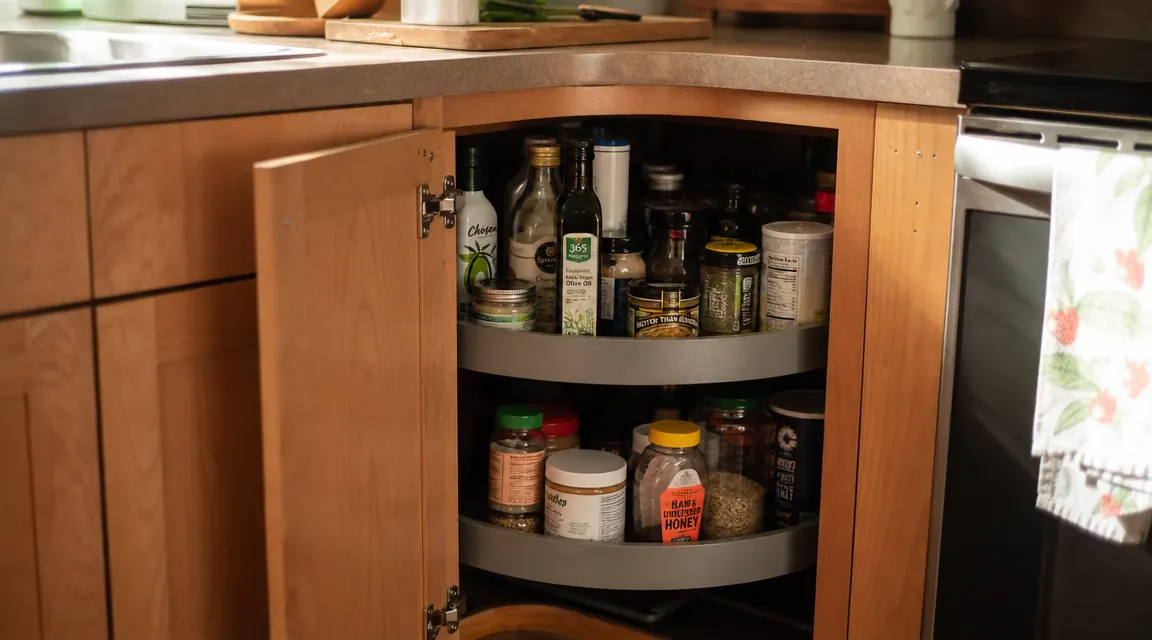
The corner cabinet above my stove had been a graveyard for eight months before I moved into this house. Dark, deep, and awkward to reach, it swallowed bottles whole. I knew exactly what was back there because I had shoved it in myself: three kinds of vinegar, fish sauce, two bottles of Worcestershire, a jar of tahini I bought in October and used once. None of it was coming out without me basically climbing onto the counter. I had tried a second shelf riser. I had tried grouping things in a basket. Neither worked because the cabinet is 19 inches deep and nothing you shove to the back comes out without a fight. I bought the Copco Non-Skid Turntable, 12-inch, for one reason: I wanted to stop losing condiments in my own kitchen.
That was eight months ago. I have spun that turntable at least twice a day since. Here is the full report.
The Quick Verdict
Genuinely solves the deep-cabinet dead-zone problem for under twenty dollars. Grip holds on wood and laminate shelves. Worth buying if your cabinet is 13 inches or deeper.
Amazon Check Today's Price →Stop losing things in your own cabinet.
The Copco 12-inch turntable has a 4.8-star rating from over 6,700 buyers. Check the current price on Amazon.
Amazon Check Today's Price on Amazon →How I've Used It
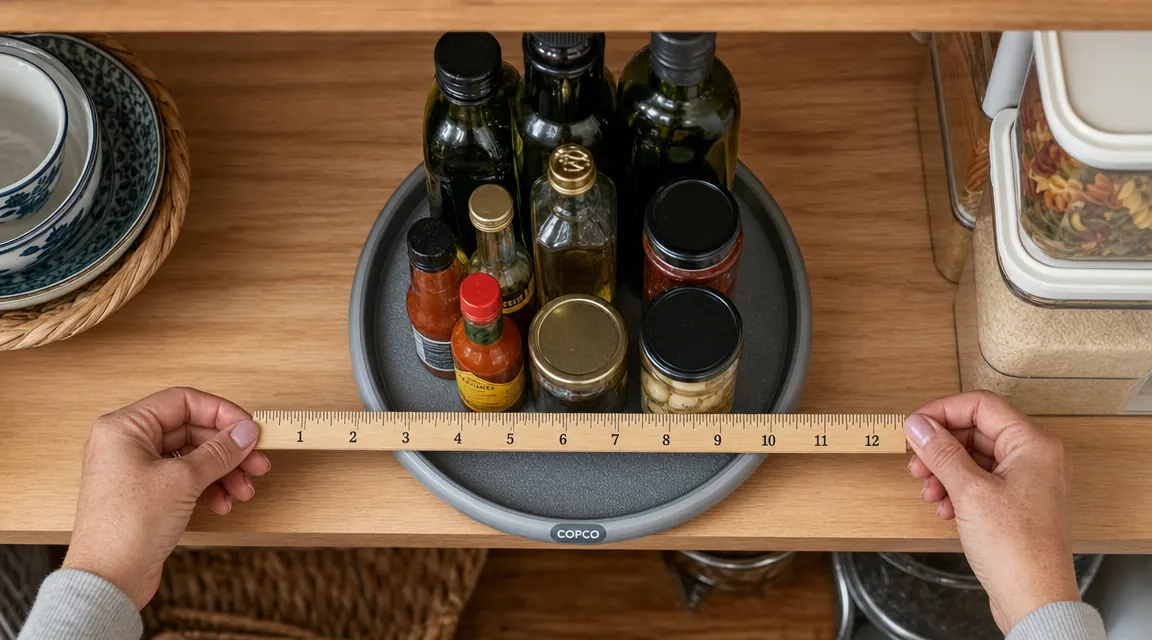
I measured the cabinet before ordering. The shelf surface is 19 inches deep by 22 inches wide. The Copco turntable is 12 inches in diameter, so it sits in the center with about 5 inches of clearance on all sides. That matters because you need room to spin without catching the back wall. If your cabinet is shallower than 13 inches, the turntable will butt up against the back and not spin freely. Anything 14 inches and up gives you enough clearance to use it properly.
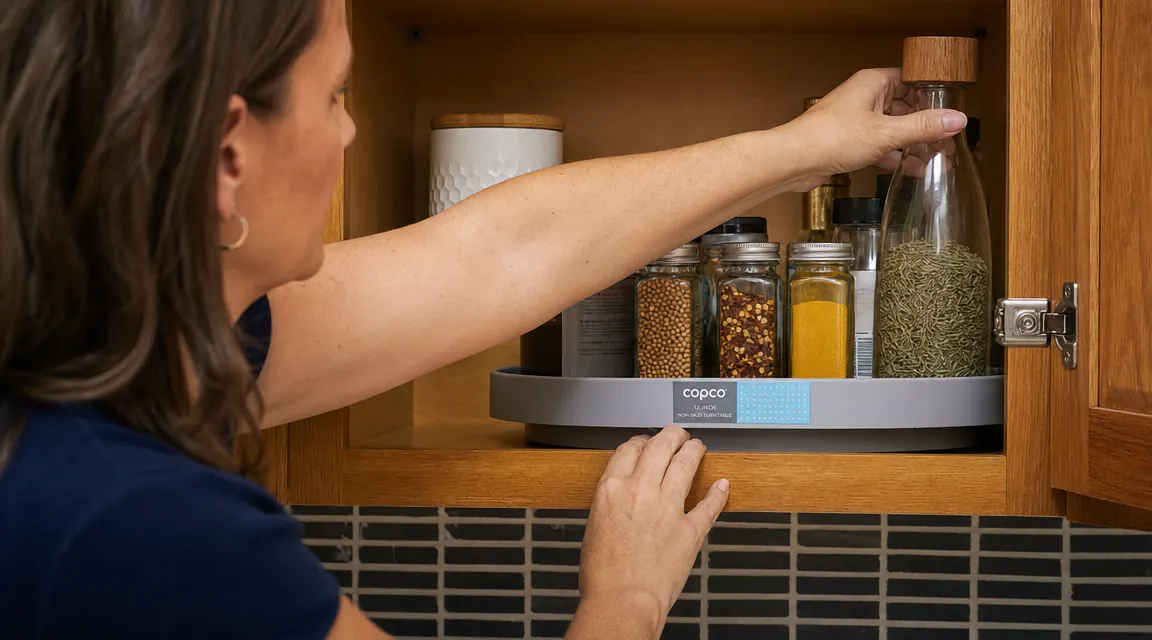
My load is heavier than average. On any given day the turntable holds a 32-oz bottle of olive oil, a 17-oz bottle of soy sauce, fish sauce, three vinegars in glass bottles, tahini, and two smaller spice jars that I kept knocking over before. That is roughly 12 to 14 pounds of glass and liquid sitting on a single 12-inch disk. Eight months later, the base has not cracked and the spin is still smooth.
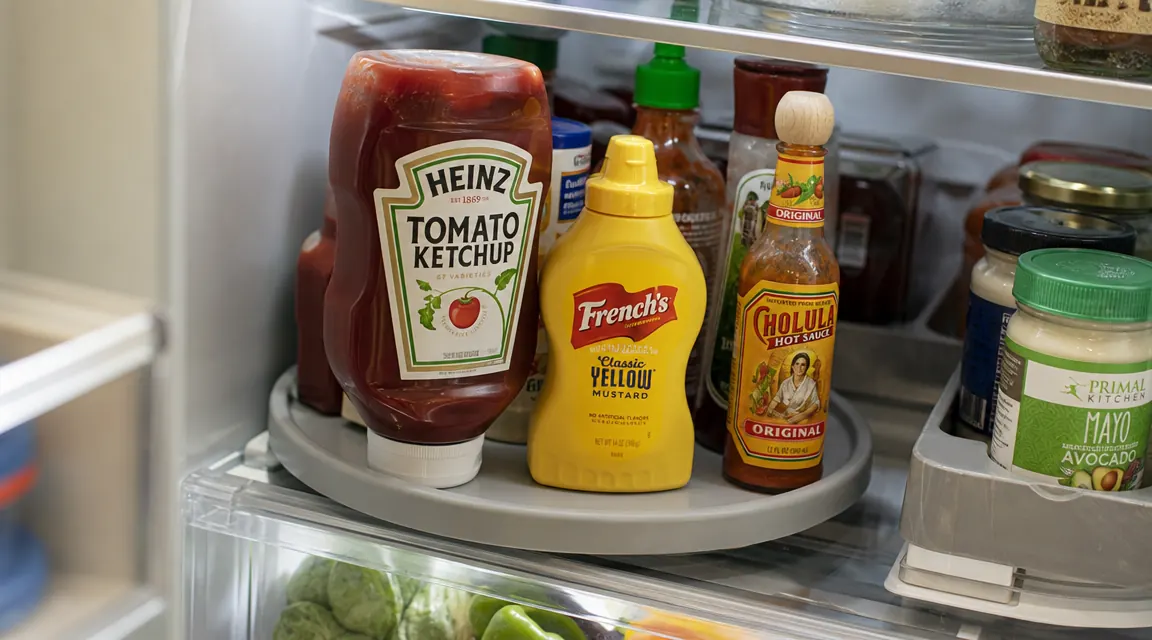
I also put a second turntable in the refrigerator, on the bottom shelf, where condiments go. That one holds ketchup, mustard, hot sauce, and a jar of pickles. Spinning it on the fridge shelf is slightly less smooth than on the cabinet shelf, because the fridge shelf is coated wire rather than solid laminate. The non-skid base grips better on flat surfaces. Still usable on wire, but you notice the difference.
What Is Actually in the Box
You get one turntable. No instructions, which you do not need. The top surface is smooth off-white plastic, and the bottom has a ring of gray non-skid rubber material around the edge. The two pieces separate for cleaning. Twist the top counterclockwise about 30 degrees, pull up, and it comes apart. I hand-washed both pieces. The rubber ring does not degrade in water. I have washed mine probably fifteen times, and it is still the same firmness and grip.
The spin is a ball-bearing mechanism in the center post. It spins freely in both directions, which sounds obvious but some cheap turntables only spin well one way. There is no ratchet, no stopping point, just a continuous smooth rotation. Full 360 in under two seconds with a normal hand push. Under a heavy load (the 12-pound setup I described), it slows to about three seconds for a full rotation, but it still spins without sticking or grinding.
Eight Months of Real Wear
The top surface has light scratches from glass bottle bottoms. You can see them if you look directly down in good light. They do not affect function. The gray non-skid ring shows no wear, no peeling, no hardening. The plastic has not discolored or gone yellow. I keep this cabinet at ambient room temperature, probably 68 to 75 degrees depending on the season, so I cannot speak to performance in extreme cold or heat.
I knocked the entire loaded turntable off the shelf once, about four months in. I pulled out a bottle from the back too fast and caught the edge. The turntable fell about 28 inches to the counter below. It bounced, spun, and landed upside down. No cracks. The non-skid ring did not separate from the base. I put it back on the shelf and it spins exactly the same. That fall was the best durability test I did not plan.
I pulled out a bottle too fast and knocked the whole loaded turntable off a 28-inch shelf onto the counter. No cracks. Still spins fine. That drop was the best durability test I did not plan.
The one area where wear has shown up is the center post connection. After about six months of twice-daily use, there is a faint wobble, maybe 2 to 3 millimeters of side-to-side play at the outer rim when the turntable is loaded. It does not affect spin quality. Nothing has fallen off the edge because of it. But if you run your hand across the surface while it spins under load, you can feel it. For a cabinet product used to store bottles, it is fine. If you were using this as a desk organizer for lightweight items, you would never notice.
The Non-Skid Claim: Does It Actually Hold
This is what I tested specifically because the non-skid base was the reason I chose this over a cheaper option. On a smooth laminate shelf, the turntable stays completely stationary when you push down and spin the top. No creep, no drift. On the painted wood shelf in my pantry closet, same result. I have never had to reposition it after spinning it, even with a heavy load.
On the coated wire refrigerator shelf, the grip is about 70 percent as good. The turntable will slide maybe half an inch if you push down hard while spinning. It is still usable and better than no turntable, but the wire shelf experience is not as clean. If your fridge has solid glass shelves, which many newer models do, the grip will be the same as on a cabinet shelf.
One thing the listing does not mention: the non-skid ring does not protect items from sliding off the turntable surface. The top is smooth plastic. Glass bottles with flat bottoms stay put fine. But if you put something with a curved or tapered bottom on it, like a wine bottle or a tall conical spice container, it can slide outward on a fast spin. Keep that in mind if you plan to use this for anything with an unusual base shape.
Sizing and Fit for Real Cabinets
The 12-inch diameter is the right call for most standard upper cabinets and refrigerator shelves. I measured every cabinet in my kitchen before buying and the most common shelf width was between 14 and 22 inches. The 12-inch turntable fit all of them with enough clearance to spin. Copco also makes a 9-inch version, which I would use for a refrigerator door shelf or a narrow spice cabinet. The 16-inch version is available if you have a large lower cabinet or a pantry shelf where you want to hold more.
Height clearance matters too. The turntable itself is 1.5 inches tall at the rim. If you have bottles that are already close to the underside of the shelf above, measure before you load it. You are effectively raising every item by 1.5 inches. In my cabinet, the clearance between shelves is 14 inches, so this was not an issue. In lower cabinets where you have a fixed shelf above, check your vertical clearance first.
What I Liked
- Non-skid base genuinely holds on laminate and painted wood, no repositioning needed
- Spins smoothly in both directions under a 12-plus pound load after eight months
- Top and base separate easily for cleaning, rubber ring survives repeated hand-washing
- Survived a 28-inch drop onto a countertop without cracking or losing function
- At 12 inches, fits most standard upper cabinets with enough clearance to spin freely
- No assembly, no tools, no drilling, fully renter-friendly
Where It Falls Short
- Smooth top surface lets tapered or curved-bottom containers slide outward on a fast spin
- Faint wobble in the center post developed after about six months of heavy daily use
- Non-skid grip is noticeably weaker on coated wire fridge shelves versus solid surfaces
- Top surface scratches from glass bottle bottoms, visible in direct light after a few months
- No handle or lip to grab, so you have to spin by touching your bottles rather than the turntable itself
Who This Is For
You need this if you have a cabinet that is deeper than 13 inches and you routinely reach past the front row of items to get to the back. That is the entire use case. Corner upper cabinets, deep pantry shelves, refrigerator shelves where condiments pile up, medicine cabinets with more than one row of bottles. If you are in a rental and cannot install a pull-out drawer insert, this is the next best thing at a fraction of the cost and zero damage to the shelf surface.
It is also genuinely useful for under-sink storage if your cabinet has a solid floor and you need to access cleaning products from the back. I use one under my bathroom sink for holding hair products and have the same positive experience. The only difference is the bathroom cabinet floor is vinyl, which grips the non-skid base as well as laminate.
Who Should Skip It
Skip it if your cabinet is shallower than 13 inches. At that depth, the turntable cannot complete a full rotation without the back side hitting the wall. You would get maybe 180 degrees of spin, which partially helps but does not deliver the full benefit. In that case, a simple tray or a small bin on a pull-out drawer liner will serve you better.
Also skip it if you plan to store items with tapered or rounded bottoms without some kind of secondary restraint. Think wine bottles, round canisters, anything without a flat base. The turntable surface has no raised edge or grip to hold those in place during rotation. You would need a turntable with a rimmed edge, which this is not.
If you need to hold more than 15 to 16 pounds on a single 12-inch surface, buy two or step up to the 16-inch version. I have not found a weight rating listed in the product specs, but after eight months of 12 to 14 pounds I would not push beyond 16 on a 12-inch disk, purely based on how the center post has behaved over time.
How It Compares to What I Tried Before
Before the Copco, I tried a cheap no-brand turntable I found at a dollar store. It was 10 inches, no non-skid base, and the spin was rough enough that I usually just slid it rather than rotating it. That thing ended up in the donate pile in about three weeks. I also had an iDesign turntable in a previous rental, which I bought because it came in a two-pack at a lower per-unit price. The iDesign spun smoothly, but the base was polished plastic with no grip, and on a painted wood shelf it drifted every single time I spun it. I was constantly repositioning it. The grip on the Copco is meaningfully better than the iDesign in my direct experience, which is the main reason I kept buying Copco. If you want the full head-to-head comparison of Copco versus iDesign, I wrote that up separately.
For people who are ready to look at every spot in the house where a turntable might help, not just the corner cabinet, there are more placement ideas worth considering before you buy a quantity. I put together a full list of spots around the house where these actually earn their keep.
Your corner cabinet does not have to be a black hole.
Over 6,700 buyers rated the Copco 12-inch Non-Skid Turntable 4.8 stars. If your shelves are deeper than 13 inches, this is the fix. Check today's price on Amazon.
Amazon Check Today's Price on Amazon →